Nighttime Motorcycle Accidents: Proving Visibility
When you’re involved in a nighttime motorcycle accident in Florida, the question isn’t just what happened, it’s what could be seen. Florida law places specific duties on drivers to maintain proper lighting and watch for motorcyclists, but proving what was actually visible in those critical seconds before impact becomes the cornerstone of your case. Without the right evidence, you’ll face insurance adjusters who’ll claim their driver simply couldn’t see you, regardless of who was truly at fault.
Key Takeaways
- Surveillance footage from traffic cameras, dashcams, and business security systems verifies headlight functionality and lighting conditions at accident scenes.
- Florida requires headlights to be visible from 500 feet and taillights to be visible from 1,000 feet; compliance strengthens legal claims after nighttime crashes.
- Accident reconstruction experts analyze the impact, reduced reaction distances, and inattentional blindness to establish causation and negligence.
- Street lighting maintenance records can prove governmental negligence when inadequate illumination contributed to collision risk and reduced visibility.
- High-visibility gear, proper lighting equipment, and documented safety compliance contrast rider precautions against at-fault driver negligence effectively.
The Critical Role of Light Conditions in Florida Motorcycle Crashes
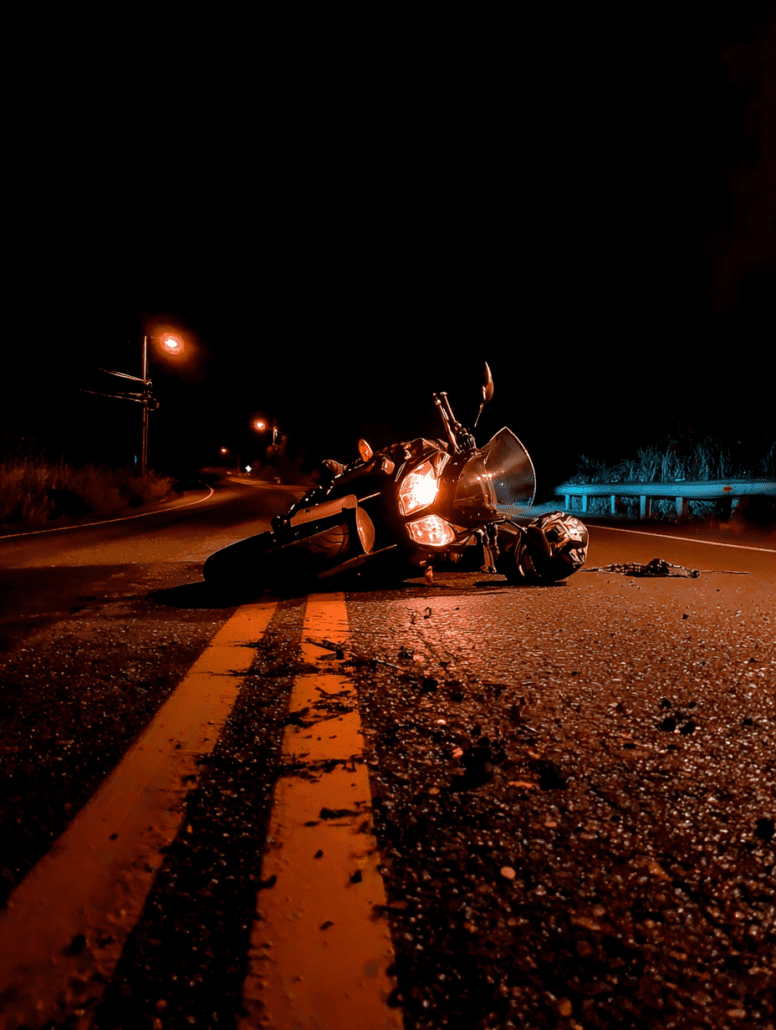
When darkness falls across Florida’s roadways, motorcycle riders face a dramatically heightened risk of collision. Reduced visibility creates dangerous conditions where other drivers simply can’t see you approaching. Statistics reveal that nighttime motorcycle accidents account for a disproportionate number of fatalities, making visibility your most vital defense.
Florida law recognizes these risks by requiring functioning headlights and taillights on all motorcycles during operation. These aren’t mere suggestions; they’re legal mandates designed to protect your life. Research consistently shows that riders using high-visibility gear alongside properly maintained lighting systems greatly reduce their accident risk.
Your safety depends on understanding how darkness amplifies every hazard you face. Poorly lit roads, limited depth perception, and drivers’ reduced awareness combine to create life-threatening scenarios. Important nighttime riding safety tips include wearing reflective clothing, ensuring your lights meet legal standards, and maintaining heightened defensive awareness. When accidents occur despite these precautions, proving inadequate visibility becomes vital to your claim.
Understanding Visibility Standards Under Florida Law
Florida’s statutory framework establishes precise lighting requirements that determine both your legal compliance and your ability to prove negligence after a nighttime crash. Under Florida law, your motorcycle must have at least one functioning headlight illuminated from sunset to sunrise, projecting white light visible from 500 feet away according to Florida Statute 316.222. You’re also required to maintain a taillight visible from 1,000 feet, ensuring drivers behind you can see your motorcycle during nighttime riding.
These visibility standards aren’t merely technical regulations; they’re evidentiary tools that protect your rights. When you comply with Florida law, you establish a baseline for reasonable conduct that strengthens your claim if another driver fails to see you. Conversely, you must use high beams when there’s no oncoming traffic to maximize your visibility.
Non-compliance can result in citations and may compromise your case. Understanding these requirements positions you to demonstrate that you took every legally mandated precaution.
How Darkness Amplifies Motorcycle Accident Severity
Although darkness reduces visibility for all motorists, it creates disproportionately lethal conditions for motorcyclists, with 39% of U.S. motorcycle fatalities occurring in dark conditions despite markedly reduced nighttime traffic volumes. When you’re managing nighttime motorcycle trips, you’re fundamentally a single moving light to other drivers, making accurate distance and speed judgments nearly impossible for them.
| Visibility Factor | Daytime Condition | Nighttime Impact |
|---|---|---|
| Detection Distance | 500+ feet | Under 200 feet |
| Blind Spots | Standard vehicle zones | Expanded notably |
| Inattentional Blindness | Moderate risk | Substantially raised |
| Fatality Rate per Mile | Baseline measurement | Dramatically higher |
| Driver Reaction Time | Adequate response window | Critically reduced |
This visibility deficit explains why nighttime motorcycle crashes produce catastrophically higher fatality rates per mile traveled. Darkness amplifies existing blind spots while triggering inattentional blindness, where drivers unconsciously fail to register your presence entirely, transforming routine encounters into life-threatening scenarios.
Mandatory Lighting Requirements for Motorcycles and Motor Vehicles
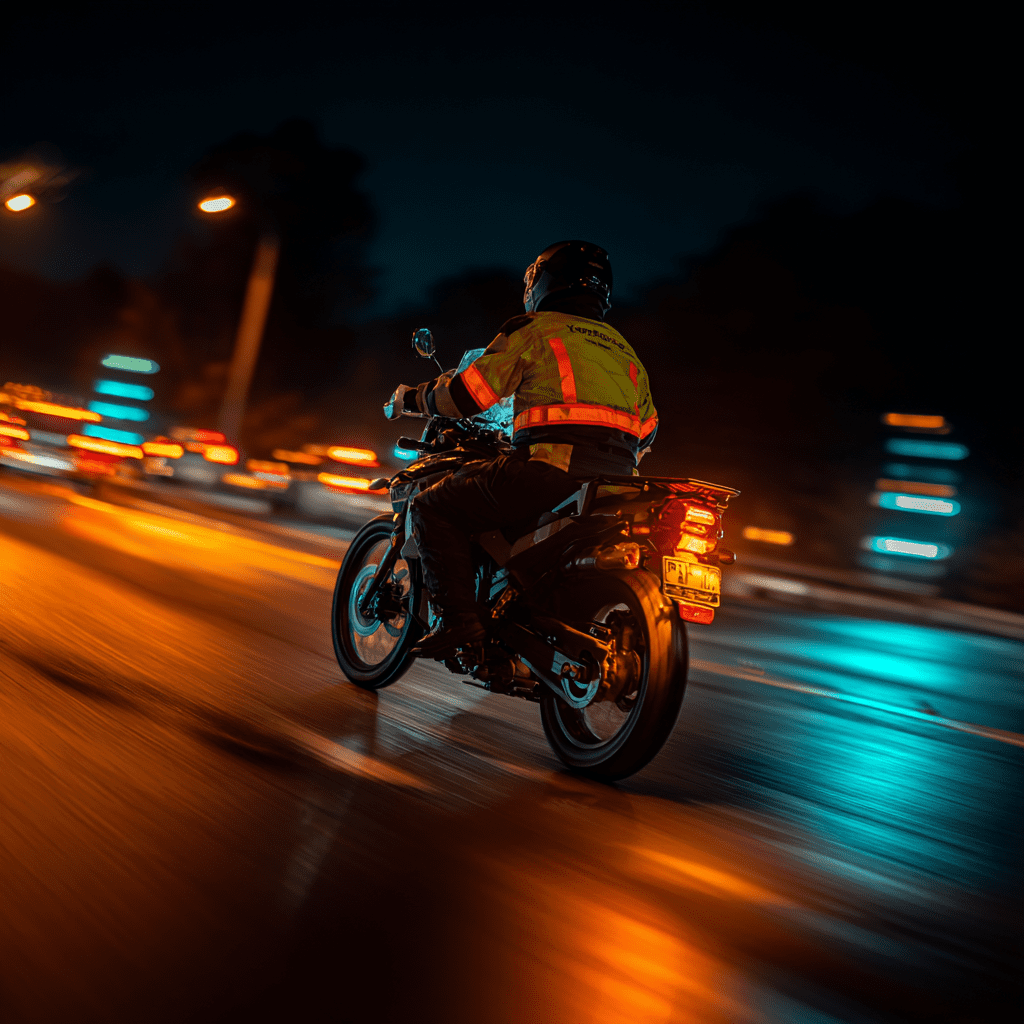
Florida law establishes specific illumination standards that can determine liability in your nighttime motorcycle accident case. Understanding these mandatory lighting requirements is crucial for protecting your rights and proving visibility failures contributed to your crash.
Florida’s Motorcycle Lighting Standards:
Headlight activation requirement: You must have your headlights turned on whenever operating a motorcycle or motor-driven cycle on public streets or highways, regardless of time of day, under Florida Statute 316.405.
Headlamp visibility range: Your headlamps must be capable of revealing persons and vehicles at specific distances, depending on beam selection. On high beam, headlamps must reveal persons and vehicles at a distance of at least 450 feet ahead under all conditions of loading. On low beam, headlamps must reveal persons and vehicles at a distance of at least 150 feet ahead.
Headlamp mounting height: Your motorcycle headlamps must be mounted at a height of not less than 24 inches and not more than 54 inches above the road surface, as specified in Florida Statute 316.400. This positioning requirement ensures proper beam projection and visibility to oncoming traffic.
White light requirement: Headlamps must emit white light that meets federal standards; any object, material, or covering that alters the headlamp’s visibility from at least 450 feet (high beam) or at least 150 feet (low beam) may not be placed, displayed, installed, affixed, or applied over a headlamp. Colored covers or films that compromise visibility are prohibited.
Equipment requirements: Your motorcycle must be equipped with at least one and not more than two headlamps complying with chapter 316 requirements, plus at least one tail lamp and a separate lamp illuminating the rear registration plate. Additionally, you must have at least one red reflector at the rear.
Beam usage standards: While Florida law requires headlights on at all times, the statute permits headlights to modulate between upper and lower beam intensity during daylight hours (sunrise to sunset) in accordance with Federal Motor Vehicle Safety Standard 571.108. This modulation capability helps balance visibility with other drivers’ comfort.
Violations of these mandatory lighting standards can establish negligence per se, strengthening your claim by demonstrating the defendant’s failure to comply with statutory safety requirements designed specifically to prevent the type of accident that injured you.
Gathering Surveillance Footage and Video Evidence
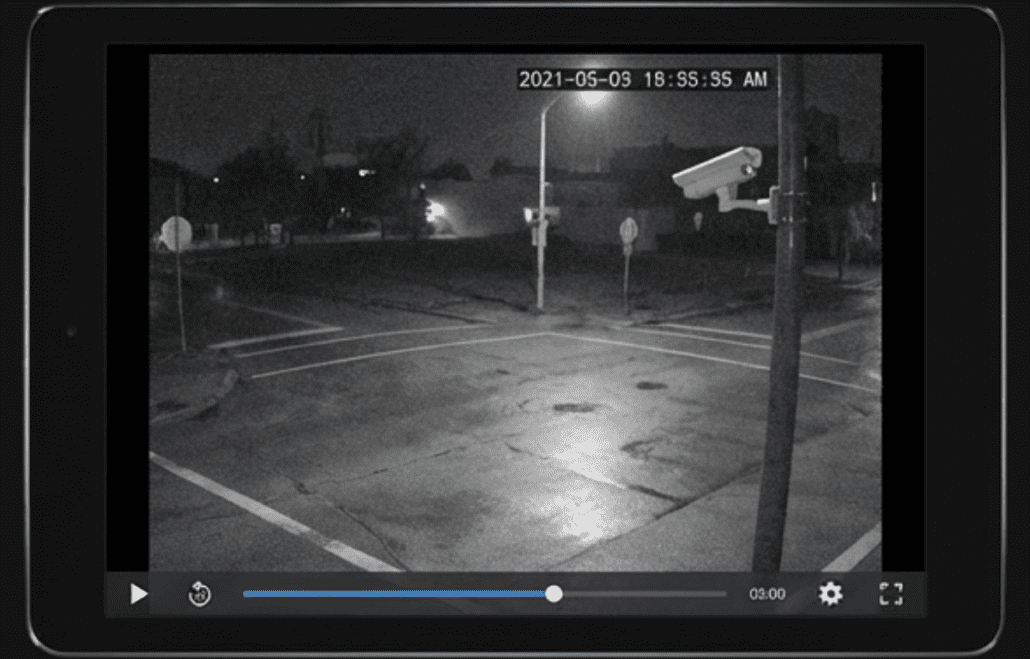
Video evidence can make or break your nighttime motorcycle accident case when lighting compliance disputes arise. You’ll need to act quickly to preserve surveillance footage, as many systems overwrite recordings within days or weeks. Traffic camera footage can verify headlight functionality and establish the exact lighting conditions when your accident occurred.
An attorney like Andrew Calandro immediately identifies all potential video sources, traffic cameras, nearby businesses, residential security systems, and dashboard cameras. This multi-angle documentation strengthens your visibility claims and helps establish negligence when street lighting was inadequate.
Don’t underestimate footage showing poorly lit intersections or malfunctioning streetlights. These recordings directly support claims against governmental entities responsible for roadway maintenance. Each camera angle provides essential evidence about what you could, or couldn’t, see in those critical moments.
Time is your enemy here. Once surveillance footage disappears, you’ve lost irreplaceable evidence that could prove visibility challenges contributed to your collision.
Street Lighting Maintenance Records as Proof of Negligence
When street lighting failures contribute to your nighttime motorcycle crash, maintenance records become powerful evidence of governmental negligence. Inadequate street lighting in Florida can evidence governmental negligence when contributing to crashes. These records can establish liability when inadequate visibility causes your motorcycle accident.
Critical documentation you’ll need includes:
- Outage reports showing non-functional streetlights at your accident location and timeframe
- Maintenance logs revealing delayed repairs or systematic neglect of lighting infrastructure
- Complaint histories demonstrating prior knowledge of lighting deficiencies
- Inspection records documenting substandard conditions before your crash
Collecting these records promptly is crucial, as they directly prove whether absent or defective street lighting created the visibility challenges you faced. When governmental entities fail their maintenance obligations, you shouldn’t bear the consequences alone. This evidence supports your claim by connecting poor lighting conditions to the negligence that contributed to your injuries.
Establishing Fault When Visibility Is Compromised
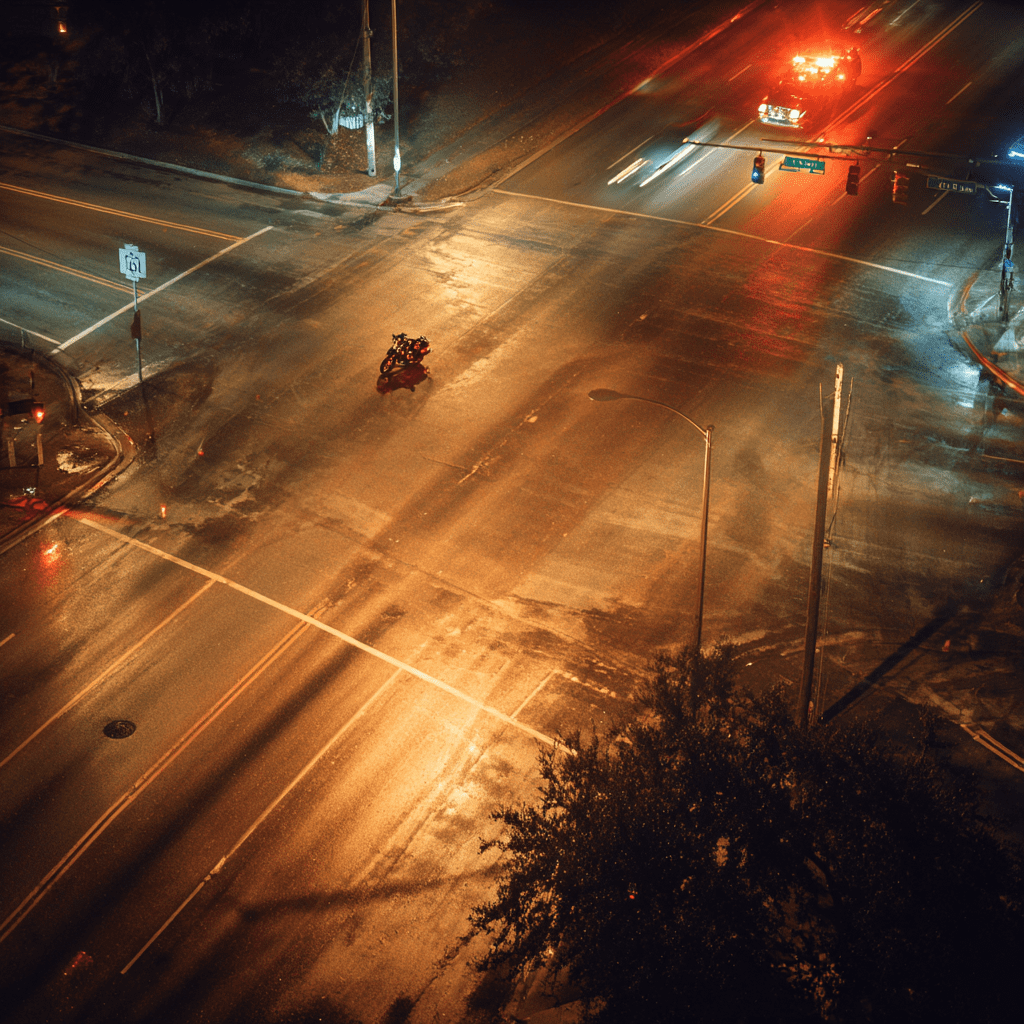
Documentation of lighting deficiencies represents just one component of your case; you must also demonstrate how compromised visibility directly caused the accident and who bears legal responsibility. When drivers fail to see motorcyclists in dark conditions, establishing fault requires proving they didn’t exercise reasonable care given the circumstances. You’ll need evidence showing whether the driver should have detected your motorcycle’s headlamp or if inadequate street lighting prevented reasonable visibility for both parties.
Florida courts examine whether drivers took appropriate precautions when visibility was compromised. This includes analyzing whether they reduced speed, maintained proper following distance, and remained alert. The Calandro Law team will gather witness statements, accident reconstruction analyses, and expert testimony to establish the causal link between poor visibility and the collision. Since motorcycle accidents often involve disputes about who had an adequate opportunity to avoid the crash, thorough evidence documenting visibility conditions becomes crucial for proving negligence and securing your compensation.
Common Insurance Company Defenses in Nighttime Crash Claims
After nighttime motorcycle accidents, insurance adjusters deploy predictable defense strategies designed to minimize payouts by shifting blame onto you. When handling your nighttime motorcycle accident in Florida, the insurance company will scrutinize every detail. They’ll argue your visibility was the problem, despite your legal right to ride with properly functioning lights. Expect these common tactics:
- Dark gear claims: Adjusters insist you should’ve worn reflective tape or brighter clothing, even though drivers bear responsibility for observing all road users.
- Excessive speed allegations: They’ll suggest slower speeds could’ve prevented the crash, often without supporting evidence.
- Unfounded impairment accusations: Claims of rider intoxication surface despite toxicology results proving otherwise.
- Road lighting deflection: Insurers minimize inadequate municipal lighting responsibilities, pushing fault onto you instead.
Documented compliance with Florida’s always-on headlight rule counters these effectively.
Expert Testimony on Visibility and Accident Reconstruction
Because visibility conditions directly determine liability in nighttime motorcycle crashes, expert witnesses provide the technical analysis courts need to evaluate your claim accurately. Accident reconstruction specialists examine how darkness affected the driver’s ability to detect your motorcycle, which typically appears as a single moving light during nighttime hours. They’ll analyze roadway lighting deficiencies under KRS 189.030 and KRS 189.040, demonstrating how inadequate streetlights increase crash risk.
Experts analyze how darkness impaired detection, quantifying reaction distances and inattentional blindness under Florida lighting laws. These professionals quantify reduced reaction distances and explain phenomena like inattentional blindness that plague nighttime driving. They’ll correlate traffic camera footage, first responder records, and street lighting maintenance logs to reconstruct precise visibility conditions at your accident scene.
This technical evidence strengthens your position against insurance companies attempting to shift blame. Your legal team uses these experts to transform complex visibility science into compelling proof of negligence.
Documenting Road Conditions and Environmental Factors
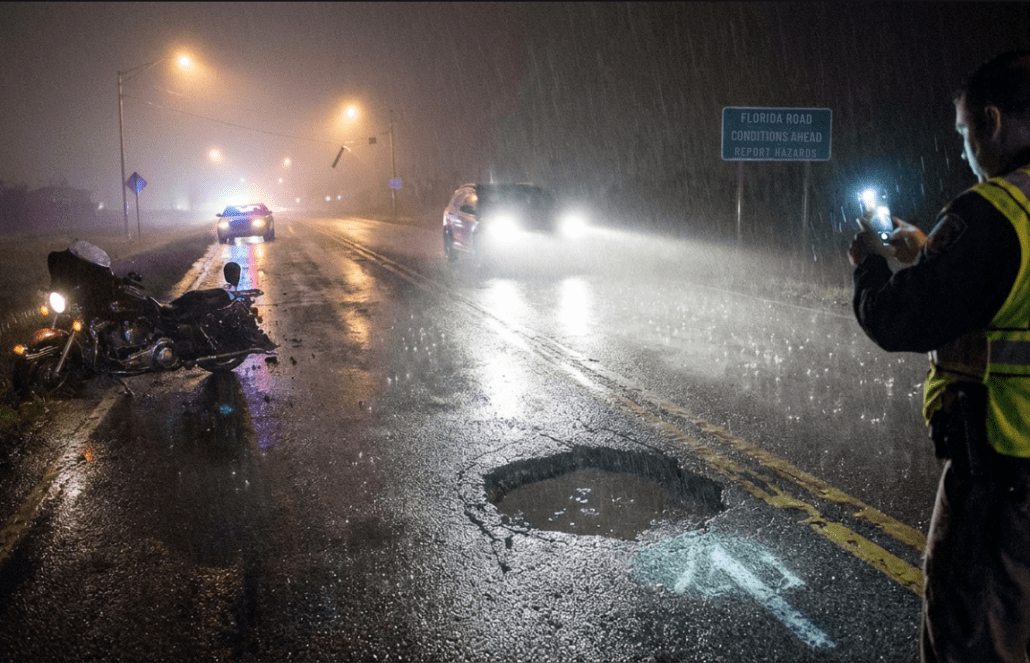
When darkness obscures critical details at your crash scene, immediate documentation of road conditions becomes your strongest defense against disputed liability claims. Environmental factors like rain, fog, and snow dramatically reduce visibility, and wet pavement creates glare that obscures lane markings, making safe navigation nearly impossible for motorcyclists.
Your evidence-gathering should include:
- Photographs of inadequate road lighting, where insufficient illumination contributed to the collision
- Street lighting maintenance records prove the municipality’s failure to maintain proper visibility standards
- Weather condition reports documenting rain, fog, or other factors that reduced your ability to see hazards
- Pavement condition evidence shows how wet or damaged surfaces created additional visibility challenges
Florida law requires motorcycles to illuminate 300 feet ahead, but you can’t comply when environmental factors and poor road conditions work against you. Documenting these visibility challenges immediately strengthens your claim and helps establish negligence by those responsible for maintaining safe roadways.
Maximizing Compensation in Low-Light Motorcycle Accident Cases
Thorough documentation of visibility challenges sets the foundation, but converting that evidence into maximum financial recovery requires a strategic presentation of your damages. Your compensation claim must demonstrate how the low-light conditions directly contributed to your injuries and losses.
We’ll emphasize your adherence to Florida’s strict night riding safety standards under F.S. 316.405 and F.S. 316.217, including the mandatory requirement for active headlamp illumination at all times. If you wore high-visibility gear and maintained functioning lights, we’ll contrast this with the at-fault driver’s negligence, perhaps their failed headlights or failure to detect you despite your precautions.
Insurance companies often exploit visibility arguments to diminish claims. We counter by presenting surveillance footage, street lighting maintenance records, and expert testimony about nighttime motorcycle visibility standards. When governmental entities failed to maintain adequate lighting, we’ll pursue additional liability claims.
Your losses, medical expenses, lost wages, pain and suffering, deserve full recognition. We’re committed to securing maximum compensation while treating you like family throughout this process.
Frequently Asked Questions
What Does 2 Fingers Down Mean for Bikers?
When you see a biker extend two fingers down while riding, you’re witnessing a gesture of respect and solidarity within the motorcycle community. This tradition represents camaraderie among riders, acknowledging your shared passion and connection on the road. Dating back to the 1970s biker culture, it’s become a symbol of unity and mutual support. While you’re participating in this meaningful tradition, remember that visibility and safety, especially during nighttime rides, must always remain your top priority.
How Can Motorcyclists Make Themselves More Visible at Night?
You’ll dramatically reduce your crash risk by 37% when you wear high-visibility gear with reflective materials at night. Keep your headlights on constantly and add auxiliary LED lights to enhance your presence on dark roads. Position yourself strategically in traffic, avoiding blind spots, and verify your lights meet legal standards by illuminating at least 500 feet ahead. Regular maintenance of all lighting systems isn’t just smart, it’s your lifeline when visibility matters most.
What Is the 12 Second Rule for Motorcycles?
The 12-second rule means you should scan the road 12 seconds ahead while riding, giving you essential time to spot hazards and react safely. This visual lead helps you anticipate traffic changes, obstacles, and road conditions, especially important during nighttime rides when visibility drops considerably. By practicing this rule, you’ll enhance your situational awareness and create a safety buffer that can prevent collisions. If you’ve been injured despite following safe riding practices, we’re here to help you prove negligence and secure the compensation you deserve.
Where Do 70% of Motorcycle Accidents Occur?
Like the crowded streets where vulnerability meets volume, 70% of motorcycle accidents occur in urban areas, where traffic density and complex intersections create collision hotspots. You’re traversing environments where visibility challenges multiply at night, especially at poorly lit intersections. If you’ve been injured in an urban motorcycle crash, Calandro Law understands these unique dangers. We’ll gather surveillance footage, lighting evidence, and expert analysis to prove negligence and fight for your rightful compensation. You’re not alone in this.
Conclusion
You’re three times more likely to suffer fatal injuries in a nighttime motorcycle crash than during daylight hours, a sobering statistic that underscores why proving visibility is paramount to your case. Your ability to secure fair compensation depends on carefully documenting lighting conditions, preserving surveillance evidence, and demonstrating how darkness contributed to your injuries. Don’t let inadequate visibility become an insurer’s defense. You’ll need experienced legal representation to transform visibility challenges into compelling evidence that supports your rightful claim. For aggressive advocacy and proven results after a motorcycle accident, trust Calandro Law.